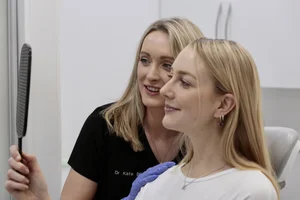
Is your chin underdeveloped?
If you've ever looked at a side photo of yourself and felt your nose looked bigger, your jawline looked shorter or the area under your chin looked heavier, your chin may be the reason.
A recessed chin changes how your whole face reads. It's one of the most common things I see in clinic, and one of the most overlooked, because we spend our lives looking at ourselves from the front. Here is how to check your own profile, and what to do if your chin sits back.
[chin-hero]
How to tell: a simple profile check
Doctors assess the chin from the side, not the front. You can do a quick version at home.
Take a side photo with your head level, looking straight ahead. The line from the top of your ear canal to the bottom of your eye socket should be parallel to the floor.
Draw a vertical line, perpendicular to the floor, starting at the point between your eyebrows and running straight down the face.
Look at where your chin sits. In a balanced profile, the front of the chin lies on or close to that line. If it sits clearly behind it, your chin may be recessed.
For a second check, draw a line from the tip of your nose to the front of your chin. Your lips should sit just behind that line.
This is a guide, not a diagnosis. Faces vary, and a doctor will also look at your bite, your jawline, your neck and your age. That is what an assessment is for.
[profile-diagram]
What is an underdeveloped chin?
A recessed or underdeveloped chin (the medical term is retrognathia when the lower jaw sits back, or microgenia when the chin itself is small) means the chin sits behind where it would balance the nose and lips. It is a difference in bone structure and proportion, not a flaw.
Why it happens
Genetics. Many people simply inherit a smaller or set-back lower jaw.
Bite and jaw growth. An overbite or a lower jaw that grew less than the upper can make the chin look set back.
Ageing. Bone and soft tissue volume reduce over time, so the chin can recede and the jawline soften.
Habits in childhood. Long-term mouth breathing and other factors can influence how the jaw develops.
What it can look like
A nose that appears larger than it is
A short or soft jawline, with a less defined angle under the chin
A heavier neck or the look of a "double chin" even at a healthy weight
A profile that looks flat or unbalanced in photos and video calls
Not only about looks
In some people a recessed lower jaw goes with changes in function. These include an incomplete lip seal (the lips don't close easily at rest), dribbling or mouth breathing, and snoring or disturbed sleep.
Dermal filler does not treat any of these. If you notice them, please see your GP or dentist, and ask about a sleep assessment if snoring or tiredness is a concern. A jaw that sits well back can also be a matter for an orthodontist or maxillofacial surgeon.
Your options
1. Orthodontics and jaw surgery (max fax). For a significant difference in jaw position, particularly when the bite or breathing is affected, an orthodontist and a maxillofacial surgeon can move the jaw itself. This is the only route that changes the bite and the airway. In children and teenagers, an early review matters because treatment can work with growth.
2. Surgical chin augmentation. A genioplasty repositions the chin bone, and a chin implant adds projection. Both give a permanent result, with the recovery, scarring and risks of surgery.
3. Non-surgical profile balancing with dermal filler. Carefully placed dermal filler can add projection to the chin and improve the line of the profile, with no surgery and little downtime. It is not permanent, and it will not change your bite or your breathing.
4. No treatment. Your profile is yours. Understanding it is the first step, and plenty of people choose to leave it as it is.
Working alongside your dentist or maxillofacial surgeon. Dermal filler is never a replacement for orthodontics or jaw surgery. I work in conjunction with dentists, orthodontists and maxillofacial surgeons, not instead of them. If your bite, jaw position or breathing needs specialist care, that comes first, and filler can sit alongside it to refine the profile. If you are already under a specialist, I am happy to work with their plan and, with your consent, liaise with them.
A real case: profile balancing for retrognathia
One of my patients came to me with a recessed chin and a profile she wasn't happy with. After a full assessment of her face in profile and from the front, we agreed a gradual plan using dermal filler.
She had 4 ml of dermal filler placed over two appointments. Building up in stages lets us add projection gradually, check the balance from every angle and keep the result natural. She has kindly consented to her photographs being shared.
[chin-case]
The before and after photos are on my Results page. Every face is different, and results vary from person to person.
How long does it last, and is it safe?
Chin filler typically lasts around 18 months, though this varies from person to person. It is gradually broken down by the body, so you can top up or stop.
In clinic, treatment is doctor-led. I assess your anatomy before we start, use a careful technique and place filler with safety in mind, including the blood vessels in the area. Common effects are swelling, tenderness and bruising for a few days. Less common risks include asymmetry or lumps, and, rarely, serious complications such as a blocked blood vessel, which I am trained to recognise and manage. You will always have a consultation first, and we will talk through the risks and your alternatives before you decide.
FAQ
Can filler fix a receding chin?
It can improve how the chin and profile look by adding projection. It does not move the jaw or change your bite.
Will it look natural?
The aim is balance, not a bigger chin. Building up in stages helps keep it natural.
How long does chin filler last?
Around 18 months on average, but it varies from person to person.
Is it painful?
Most people find it comfortable. Numbing is used, and filler also contains local anaesthetic.
Is it suitable for everyone?
Not always. If your bite, jaw position or breathing is affected, I may suggest you see an orthodontist or maxillofacial surgeon first. We will discuss this at your consultation, and I will refer you on or work alongside your specialist where that is the right thing for you.
Do you treat under-18s?
No. I treat adults only. If you are concerned about a child or teenager's jaw development, an early review with an orthodontist or maxillofacial surgeon is the right place to start.
What about snoring or dribbling?
Filler doesn't treat these. Please speak to your GP.
Book a consultation
Not sure whether your chin is the issue? A consultation is the place to start. I will assess your profile with you, explain what is possible and tell you honestly whether treatment would help. The consultation fee is £75, and it can be redeemed against treatment if you go ahead in the same appointment.
Book a consultation with Dr Kate at The Cosmetic Dental Gallery in Battersea: book online
Dr Kate Bennett-Brown MBChB BMedSc (Hons) MRCS is a doctor-led aesthetic practitioner in Battersea, London. Results vary and every treatment begins with a consultation.